
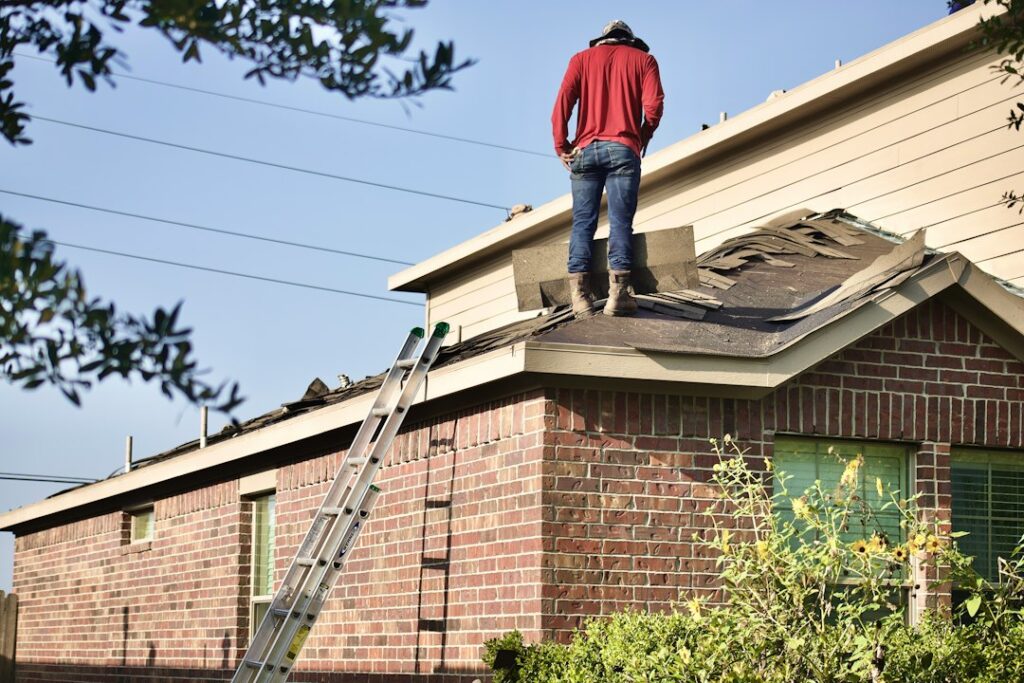
What should homeowners look for in a roofing contractor?
The right roofing contractor should be able to explain the condition of the roof, provide a clear written scope of work, show proof of insurance, and answer questions without pressure. Price matters, but it should be compared only after confirming that each proposal covers the same materials, preparation, ventilation, flashing, cleanup, and warranty terms.
Roofing work is a significant home expense and a safety-sensitive project. A contractor who communicates clearly before work begins is more likely to manage details responsibly once the project is underway.
How can a homeowner verify a contractor’s qualifications?
Start by confirming the contractor’s business identity, experience, insurance, and local requirements before signing anything.
Ask for:
- A certificate of general liability insurance
- Workers’ compensation coverage when employees will be working on the property
- A written contract with the contractor’s legal business name and contact information
- References for recently completed roofing projects
- Details about who will perform the work if subcontractors are involved
- Information about permits or inspections that may apply
New York State does not issue one general home-improvement contractor license for every roofing business. Licensing and registration requirements can depend on local government rules and the type of work involved. Residents should verify current requirements with the appropriate building department rather than assuming that a contractor’s advertisement or business card proves compliance.
Insurance should be verified directly through the insurance carrier or an official certificate. A verbal assurance is not the same as documentation. Homeowners should also be cautious if a contractor asks them to obtain permits in their own name without clearly explaining why.
What should a roofing proposal include?
A useful proposal describes the work in enough detail that another contractor could reasonably price the same project. A vague statement such as “replace roof” does not provide enough information for a fair comparison.
The written proposal should identify:
- The roofing material, style, color, and manufacturer
- Whether the work is a repair, partial replacement, or complete tear-off
- The number of existing roofing layers to be removed
- Underlayment, ice-barrier, flashing, and ventilation details
- Treatment of chimneys, skylights, plumbing vents, valleys, and roof edges
- Replacement of damaged decking and how extra charges will be handled
- Protection for siding, landscaping, driveways, and outdoor equipment
- Debris removal and final cleanup
- Start and completion expectations
- Payment schedule and cancellation terms
- Workmanship and manufacturer warranty information
Homeowners should ask whether the contractor plans to install new flashing or reuse existing flashing. Reusing old flashing may be acceptable in limited situations, but it should be explained rather than left unstated.
How many roofing estimates should a homeowner get?
Two or three detailed proposals usually provide a useful comparison. More proposals are not automatically better if each one uses different assumptions.
A low bid may reflect fewer layers being removed, thinner materials, limited flashing work, no allowance for damaged decking, or minimal cleanup. A higher bid may include more complete preparation rather than simply charging more for the same roof.
Compare proposals line by line. Ask why the scope differs, not just why the price differs. If one contractor includes replacement of pipe boots and another does not, the totals are not truly comparable.
What roofing experience matters in Clarence?
Roofing in Clarence must withstand repeated cycles of snow, freezing temperatures, rain, wind, and seasonal thawing. Western New York weather can change quickly, and localized lake-effect snow may place additional stress on roofs in some winters.
That makes installation quality especially important. A contractor should be prepared to discuss:
- Ice-dam prevention and proper ice-barrier installation
- Adequate attic ventilation
- Snow and wind exposure
- Secure flashing around roof penetrations
- Proper fastening for the selected roofing material
- Safe work practices during cold or wet conditions
Older homes and homes with additions may have several roof sections, different slopes, or previous repairs. A contractor should inspect how those areas connect instead of treating the roof as a single uniform surface.
Roof age alone does not prove that replacement is necessary. Missing shingles, recurring leaks, widespread granule loss, sagging, damaged flashing, and deteriorated decking are more useful indicators when evaluating the roof’s condition.
What questions should be asked before signing a contract?
A short conversation can reveal whether the contractor has carefully evaluated the property.
Useful questions include:
- Who will supervise the work each day?
- Will the crew be employees or subcontractors?
- How will weather delays be handled?
- What happens if rotten decking is found?
- How will the property be protected during tear-off?
- Where will materials and debris be placed?
- How will magnetic nail cleanup and final inspection be handled?
- What maintenance or warranty exclusions apply?
- Who should be contacted if a leak appears after completion?

Answers should be specific. Statements such as “everything is covered” or “the roof will be done properly” do not replace written terms.
What warning signs suggest a contractor should be avoided?
Certain practices deserve caution, especially when combined.
Warning signs include:
- Pressure to sign immediately
- A request for full payment before work begins
- No written scope of work
- Refusal to provide insurance information
- Unusually large differences between the spoken price and written price
- Requests to pay only in cash
- A contractor who cannot explain ventilation or flashing
- Unwillingness to identify subcontractors
- Claims that a homeowner’s insurance company guarantees the repair
- Storm-related door-to-door solicitation demanding immediate action
After a major storm, temporary repairs may be necessary to prevent water damage. Even then, homeowners should document visible damage, avoid climbing onto the roof, and review any agreement carefully before authorizing permanent work.
Are permits required for roof replacement?
Permit requirements can depend on the specific project and local rules. A simple replacement of roofing material may be treated differently from structural repairs, changes to roof framing, or work involving additions and alterations.
The contractor should explain whether a permit is needed, who will obtain it, and whether an inspection is expected. Homeowners should not assume that a permit is unnecessary simply because the project appears routine. Requirements may also change, so current information should be confirmed with the local building department before work starts.
How can homeowners protect themselves during the project?
Keep copies of the contract, insurance documents, receipts, change orders, photographs, and warranty information. Photograph the roof and surrounding property before work begins, especially landscaping, siding, windows, decks, and driveway surfaces.
Do not approve additional work solely through a casual text message if the change affects the price or scope. A written change order should identify the new work, added cost, and any effect on the schedule.
During the project, avoid walking through active work areas. Roofing materials, exposed nails, ladders, and tear-off debris can create hazards for residents, children, and pets. A final walkthrough should address cleanup, visible damage, unfinished details, and documentation for future maintenance.
The best choice is not necessarily the cheapest contractor or the largest company. It is the contractor whose qualifications can be verified, whose proposal is detailed, whose installation plan fits local weather conditions, and whose agreement clearly explains what will happen before, during, and after the roofing work.
